
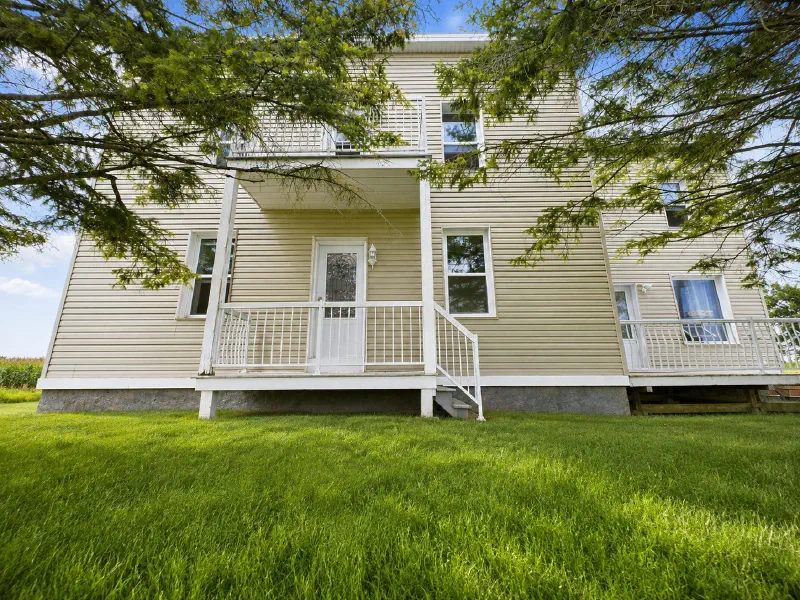
 Sold
Country Home with Barn, Saint-Hermas, Mirabel
4071, rang Saint-Hyacinthe, Mirabel (Saint-Hermas), QC
4 bed
2 bath
View Details →Updated · By Georges Matar, residential real estate broker
This summer in Mirabel, half of the single-family homes sold went for $650,000 or more, and that figure brings together the new streets of Saint-Janvier and the country roads of Saint-Hermas. Send me the address: I will show you the sales that truly compare with your house, a price range and the amount you would have left after the sale.
No contract to sign. The analysis is yours, whether you sell or not.
(438) 372-0102 · I'd rather text · georges.matar@remax-quebec.com
Get my free evaluation
The address is enough to start. Answer within 24 hours.
In Mirabel, the median price of a single-family home was $650,000 in the third quarter of 2026, up 11% over one year, according to Centris statistics. Over the last four quarters, it stands at $647,750 for 572 sales. The median condominium sold for $462,000 in the quarter, and the plex of 2 to 5 units for $841,312 over one year.
This figure covers 13 sectors, separated by an agricultural zone that occupies 87% of the territory, according to the City, and Centris publishes them as a single block. A 2018 two-storey house near the Saint-Janvier train station and a house on a Saint-Hermas country road fall into the same median, even though no buyer puts them side by side.
The price of yours depends on its sector, its age and what has been redone, the lot and what the zoning allows on it, the garage, the basement and, outside the urban cores, the well and the septic system.

Georges Matar
Trained as a biomedical engineer, member of the Ordre des ingénieurs du Québec, holder of a doctorate. Residential real estate broker, OACIQ licence J7941, RE/MAX DU CARTIER INC., real estate agency.
Before brokerage, I spent about ten years in scientific research, taught for eight years in a faculty of engineering and was regional manager of biomedical engineering in Nunavik. One habit stayed with me: a figure given without its margin of error means nothing. A home evaluation is a measurement. I treat it as one.
This is a comparative market analysis prepared by a real estate broker, not a chartered appraiser’s report. It is meant to help you decide whether selling is worth it, when, and at what list price.
In Mirabel, a recent house is also measured against new construction. According to the 2021 census, 39% of the city’s dwellings were built from 2011 to 2021, and 22% from 2001 to 2010. The buyer of a 2015 two-storey house can visit a builder’s model home the same day, and totals must then be compared: the GST and QST apply to the sale of a new home, not to that of a home that is not new, according to Revenu Québec.
Single-detached houses make up 63% of the housing stock, against 5% for semi-detached and row houses. A semi-detached house therefore has few similar sales to back it up, and its range widens accordingly.
In the rural sectors, houses are not much alike. A country home in Saint-Hermas, sold this year and shown below, was built in 1935, with a barn, on a lot bordering farm fields; only 7% of the city’s dwellings date from before 1960. No Saint-Janvier sale serves as a comparable for it, and the houses along the country roads of Saint-Benoît or Sainte-Scholastique resemble it only in part: each difference in lot, buildings or zoning is priced separately, and the range is wider than in town.
For that house, the comparables had to be found farther away, and farther back in time: the agricultural zone is sparsely populated, and sales there are rare. Each element, the barn, the land, the age of the house, was given its contributory value, that is, what it adds to the price in a buyer’s eyes, measured on sales and not on what it cost. In a zone like that one, comparables are handled with meticulous care and caution, and every concluded sale counts.
Three to six properties similar to yours, sold in the last six months when there are enough sales, further back otherwise, and I then tell you why. For each one: its listing sheet, sale price, time on market, and what brings it closer to or sets it apart from your home.
Two figures side by side: the list price I would recommend and the probable sale price. The gap between them is the negotiating margin buyers in your area obtained on recent sales, measured by the difference between asking price and price paid.
The probable price, minus your mortgage balance, the prepayment penalty if any, the broker’s fee and its taxes, the mortgage discharge at the notary and a new certificate of location if yours is out of date. This is the figure that decides a plan. Good news on the price can vanish into a penalty nobody asked the lender about.
A short list, specific to your home: what takes away a reason for the buyer to negotiate (a visible repair, a missing document, a poorly presented room) and what would cost you more than you would get back. No generic renovation list.
Declaration of co-ownership, minutes of the latest meetings, contingency fund statement and fund study, building by-laws: I read them before setting the price. The buyer and their notary will read them too, and a special assessment announced in the minutes always ends up being paid in the price. I hold the Coproprié-T certification in co-ownership law.
The calculation starts from the third-quarter median. The balance, the interest rate and the fee rate are hypothetical: they show how the lines follow one another, nothing more. Your evaluation redoes this table with your figures.
| Item | Assumption in the example | Amount |
|---|---|---|
| Sale price | Mirabel single-family median, Q3 2026 | $650,000.00 |
| Minus the broker’s fee | hypothetical rate of 4%, which is negotiable | $26,000.00 |
| Minus the GST and QST on the fee | 5% and 9.975% | $3,893.50 |
| Minus the mortgage balance | hypothetical balance | $290,000.00 |
| Minus the prepayment penalty | three months’ interest at a hypothetical rate of 4.5% | $3,262.50 |
| Minus a new certificate of location | 2026 suggested fee, $1,630 plus taxes | $1,874.09 |
| Net amount, before discharge and adjustments | $324,969.91 |
The table stops before two items: the mortgage discharge, at the notary’s rate, and the tax adjustments as of the day of the deed. In Mirabel, a municipal tax bill of more than $300 is paid in four instalments, the last on September 1 in 2026, according to the City: if you sell this fall, with the bill paid, the buyer reimburses you for their share of the year.
No fee rate is imposed, either by law or by the OACIQ: the fee is negotiated, as a percentage or as a flat amount, and is written into the brokerage contract. On $650,000, one percentage point is worth $6,500, or $7,473.38 with the GST and QST. See the broker’s commission in Quebec and the real cost of selling a home in Quebec.
The $1,630 fee applies to a single-family home in an urban setting: for a lot on a country road with a barn, ask the land surveyor for a quote.
Have the penalty confirmed first: with a fixed rate, the lender takes the higher of three months’ interest and the interest rate differential, which can far exceed the example. Also ask whether your loan can follow you: the mortgage penalty, calculation and examples.
These figures cover the third quarter of 2026, July to September, and were taken from Centris on November 11, 2026. Those of the fourth quarter will replace them in mid-January 2027.
| Single-family | Condominium | Plex (2 to 5 units) | |
|---|---|---|---|
| Sales, Q3 2026 | 112 (-4%) | 47 (-21%) | 14 |
| Active listings, Q3 2026 | 180 (+26%) | 92 (+29%) | 25 |
| Median price, Q3 2026 | $650,000 (+11%) | $462,000 (+4%) | not published |
| Average selling time, Q3 2026 | 37 days (+12) | 52 days (+10) | not published |
| Sales, last 4 quarters | 572 (-2%) | 269 (-7%) | 72 (-25%) |
| Active listings, last 4 quarters | 171 (+10%) | 87 (+19%) | 25 |
| Median price, last 4 quarters | $647,750 (+8%) | $444,212 (+3%) | $841,312 (+14%) |
| Average time, last 4 quarters | 31 days (-6) | 43 days (-6) | 52 days (-4) |
Source: Centris real estate statistics for Mirabel. Changes compare with the same period one year earlier; for selling times, they are in days. Centris does not publish a median when sales are too few for a reliable statistic.
Supply rose faster than sales. The single-family median is up 11%, but sales are down 4% and active house listings are up 26%, to 180. The average selling time lengthened by 12 days, to 37, against 31 over the year: this summer, the buyer had more choice, and more time.
In months of inventory, 112 sales in three months make about 37 sales per month; at that pace, 180 active house listings represent about 4.8 months. For condominiums, 92 listings for 47 sales give about 5.9 months, with a 52-day selling time: the condo is slower than the house. For the Laurentides as a whole, the same calculation gives 6.3 months for single-family homes, and the selling time there is 49 days: Mirabel remains faster than its region.
The APCIQ, which counts a little differently, classifies Mirabel’s single-family homes by price range over 12 months: 2.8 to 3.0 months of inventory under $970,000, a market it describes as favourable to sellers, and 10.0 months at $970,000 and above, to the buyers’ advantage. The more expensive the house, the more its list price has to be defended.
For plexes, 14 sales in the quarter is too few for the annual median of $841,312 to describe your building: its income and its leases count just as much. See selling a plex.
Neither Centris nor the APCIQ publishes figures by sector within Mirabel. Yet the OACIQ asks the broker to compare with similar properties recently sold in the same sector. Here is what drives value in each part of the city.
It is the most developed hub and the closest to Highway 15, where recent construction and services are concentrated; the commuter train station is there too, according to the City. Comparables abound, and so does new construction: between two neighbouring two-storey houses, the gap comes down to age, the basement, the yard and, for those who take the train, the distance to the station.
Next to the Domaine Vert park. Where the houses on a street are close in age and size, the range tightens, and the gap between two houses comes from upkeep and the age of the renovations.
In Saint-Canut as elsewhere, a large lot commands a price, but not by the square foot: its adjustment is measured with sales of comparable lots, not with a simple proportion. In the other sectors, including Mirabel-en-Haut, comparables come from the same sector, of the same type and similar age.
These sectors remain rural, with properties on large lots, sometimes with agricultural uses. Without the authorization of the CPTAQ (Quebec’s agricultural land protection commission), and except as provided by regulation, a lot in the agricultural zone can neither be subdivided nor used for a purpose other than agriculture (Loi sur la protection du territoire et des activités agricoles, the Act respecting the preservation of agricultural land and agricultural activities, sections 26, 28 and 55). A house may rest on an acquired right (section 101), but since 2025, section 101.2 has prohibited adding a dwelling or an additional residence to it, unless a regulatory exception applies or the Commission authorizes it.
The buyer therefore also pays for what they will be able to do with the land: two houses of the same size do not compare if the rights attached to their lots differ. See buying a country home in Quebec and land value and zoning.
During the visits of the Saint-Hermas house, the buyers’ questions were mostly about zoning: the property used to be in the airport zone, and it is now in the agricultural zone. Others concerned the heritage status of a 1935 house, the compliance of the septic system, the equipment left in the buildings and the age of the building. I obtained every answer for the buyers. The house found buyers who were looking for exactly that country way of life. If you are selling a property on a country road, these are the answers to have in hand before the first visit.
Your price will also be set alongside those of the neighbouring cities. According to Centris, the single-family median stood as follows:
| City | Median, Q3 2026 | Median, 4 quarters | Sales, 4 quarters |
|---|---|---|---|
| Blainville | $835,000 | $762,625 (+4%) | 646 |
| Mirabel | $650,000 | $647,750 (+8%) | 572 |
| Boisbriand | $622,500 | $626,875 (+5%) | 162 |
| Sainte-Thérèse | $710,000 | $615,400 (+5%) | 140 |
| Saint-Eustache | $598,250 | $589,187 (+6%) | 400 |
| Laurentides, region | $573,750 | $567,487 (+6%) | 7,645 |
After Blainville, Mirabel is the city in the table that sells the most single-family homes, and its four-quarter median is rising the most (+8%). To go further: the Mirabel real estate market in the third quarter of 2026, the Laurentides, city by city and my page real estate broker in Mirabel.
The form starts with the address. Your expected selling time and your contact details cover the rest; “just exploring” is a valid answer.
I ask the questions the data cannot answer: renovations, known issues, what you plan to do next. If you don’t like the phone, we do it by text.
I present the comparables, the range and the net amount. A visit makes the analysis more precise, because condition and renovations do not show up in the data. It is not required for a first range.
List price, preparation, timeline, documents to gather. If you don’t ask for it, we stop at step 3.
| Type | Cost | What it is for | What it measures, and its limit |
|---|---|---|---|
| Municipal assessment (assessment roll) | None, it is on your assessment notice | Calculating municipal and school taxes | The market at a reference date set by law, more than two years before the first year of the roll. Done in bulk, without seeing the inside. |
| Chartered appraiser's report | Fees set by the appraiser | Lender, court, estate, tax matters | Market value, in a report signed by a member of the Ordre des évaluateurs agréés du Québec. It is the document to produce when a third party requires one. |
| Online estimator | None | A first ballpark figure | Averages and public data. It sees neither the inside, nor the renovations, nor the street. |
| Broker's comparative analysis | None here, no obligation | Deciding to sell, setting the list price, calculating the net | Recent comparable sales, adjusted to your property. A reasoned opinion of market value, not a chartered appraisal report. |
The roll in force covers 2026, 2027 and 2028, and its reference date is July 1, 2024: your assessment notice measures the market of that summer (Loi sur la fiscalité municipale, section 46).
When it came into force, it matched the market: the Quebec government sets its median proportion at 100% for 2026, against 81% in 2025 for the previous roll, based on July 2021. For 2027, it drops to 94%, a comparative factor of 1.06: a house entered on the roll at $600,000 corresponds, for a typical house, to a price of around $636,000. This ratio describes the roll as a whole, and a house on a country road with a barn fits it poorly.
The next roll, for 2029 to 2031, will start from the market of July 1, 2027. For a tax bill that is too high, that is a different process: contesting your municipal assessment. For a ballpark figure, the online estimator starts from Centris medians.
With 180 active house listings (+26%), the buyer compares. The first look comes with the alert that Centris.ca sends to buyers and their brokers; a price drop three weeks later does not recreate it. At $970,000 and above, where the APCIQ counts 10.0 months of inventory, the mistake costs months.
The price of a new model is not a comparable as is: does it include taxes, the yard, the options? Compare the totals, then what a resale can offer on top, such as an occupancy date set in the promise to purchase.
A house built under the guarantee plan for new residential buildings passes the rest of its protection on to the buyer, up to five years after the end of the work for design, construction or soil defects (regulation, sections 10 and 16). Without the builder’s contract and the receipt form in the file, the argument carries no weight in the negotiation.
Its median proportion of 100% in 2026 invites you to take it for a price. But it measures July 2024, and it was established en masse, without seeing the inside of your house.
Outside the urban cores, the well and the septic system are part of the house. Gather water analyses, pumping invoices, the permit or the plan of the system: what the buyer cannot verify, they negotiate.
Writing “intergenerational possible” or “divisible lot” in the agricultural zone, without checking, promises a use the buyer may not get: section 101.2 and the authorization required to subdivide limit it. Check the status of the lot before writing the description.
With 92 active condominium listings (+29%) for 47 sales and a 52-day selling time, the buyer has time to read. Minutes, the contingency fund statement and the fund study, ready as soon as the listing goes online, leave them one less reason to move on to the unit next door.
No season guarantees a price, but two local dynamics matter.
According to the 2021 census, 43% of Mirabel families are couples with children at home, and 21% of residents are under 15. For a child to start September in a new school, the family has to find its house in the spring: a family house listed at the end of winter arrives while it is searching.
Supply, next: 180 active house listings this summer (+26%). When choice grows, the list price weighs more than the month. Houses sell in winter too, with their own rules: selling your house in fall or winter.
Your own timeline counts for more. The form asks whether you are thinking of selling within 3 months, in 3 to 6 months, in 6 to 12 months, or whether you are just exploring; starting early leaves time to order the certificate and gather the documents for the well or the warranty.
In a city where 23% of households have four or more people, the double move takes two forms here: the family leaving a condo or a townhouse for a house with a yard, and the couple whose children have left. In both cases, two deeds of sale have to line up.
If you buy again in Mirabel, the City applies in 2026 a rate of 3% to the portion above $500,000 (by-law 2455). With its 2026 brackets, a house bought for $650,000 generates $10,110.50 in property transfer duties (welcome tax) if that price serves as the base. The base is the highest of the price paid, the stipulated price and the roll value multiplied by the comparative factor (1.00 in 2026).
See the welcome tax in Quebec, the transfer duties calculator and selling before buying.
Reviews published on my Google profile, quoted as their authors wrote them, with their agreement. The others are at the source.
I highly recommend Georges for your real estate transactions on the North Shore (Rive-Nord)! He accompanied me through every step of the sale of my house in Mirabel with professionalism and efficiency. Thanks to his excellent knowledge of the market in my area, I received all the information I needed to make the right decisions. Georges was always courteous, caring and very available. He answered all my questions quickly, which allowed me to go through the sale process with complete confidence. He also knew how to showcase my property to maximize buyers' interest. A very positive experience from start to finish!
We had an excellent experience with George for the sale of our house. He was attentive, available and always listening to our needs. He took the time to answer all our questions and accompanied us throughout the process with professionalism. We recommend him without hesitation!
Enter the address and I take care of the rest: comparable sales in your area, a reasoned price range and the net amount you would keep. No contract, no obligation.
No contract to sign. The analysis is yours, whether you sell or not.
Your contact details are used only to answer your request and are never sold. Details are in the privacy policy.