
Practical Guide
Wood Stove Rules in Montreal: What Actually Applies
A wood fireplace is not a simple amenity. It is an appliance that gets declared to the city, an emission rate you …
Practical Guide
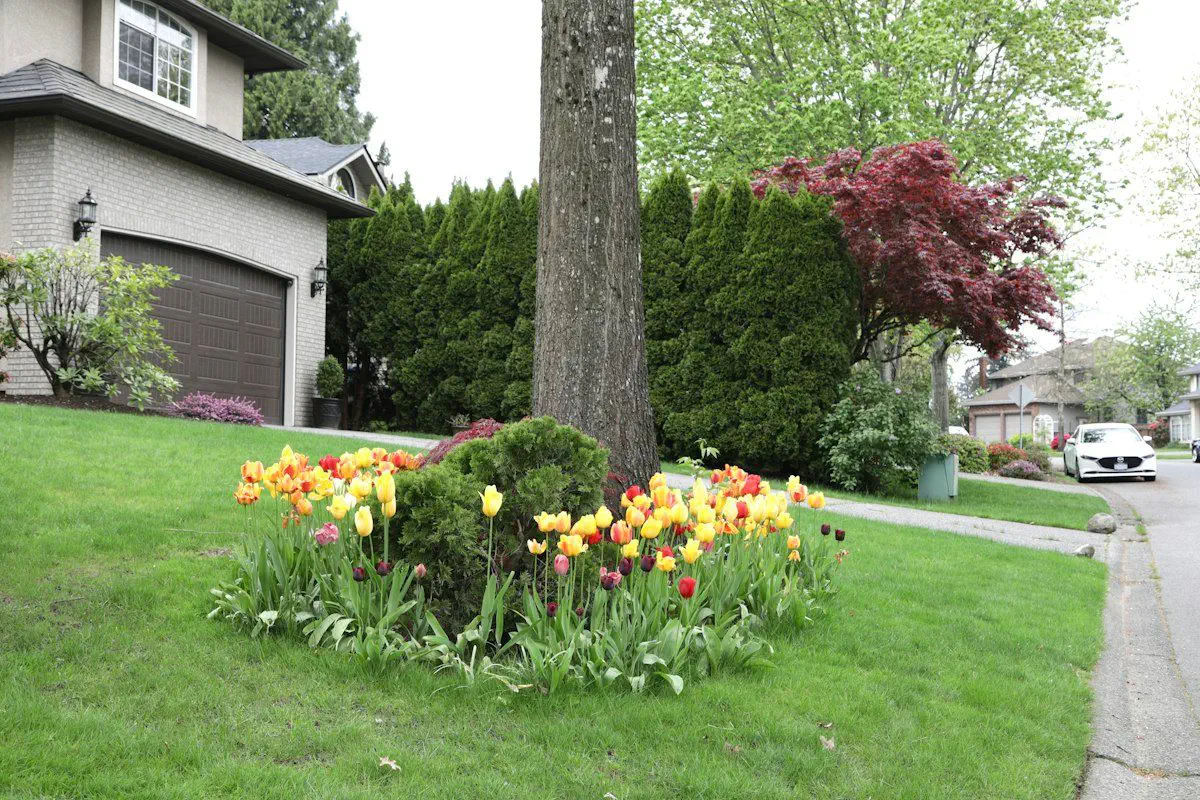
A forty year old maple in the back yard sells a photograph. It does not push a price up by a percentage I could name for you: no Quebec source lets me put a figure on what a tree is worth on a property, and I am not going to invent one. What can be verified, on the other hand, comes down to three things: who owns the tree, what you have to ask the city before you touch it, and who pays when it comes down.
The Code civil du Québec (Quebec’s civil code) devotes no article to the question “whose tree is this”. It answers it another way. Article 900 classes plants among immovables “as long as they are not separated or extracted from the land”, and article 951 adds that “ownership of the soil carries with it ownership of what is above and what is below”. The practical result: the tree follows the lot its trunk emerges from. Branches hanging over the neighbour’s yard and roots crossing the line change nothing.
The rule on fruit surprises everyone. Article 984 is short and blunt: “Fruit that falls from a tree onto neighbouring land belongs to the owner of the tree.” So the apples that fell in your yard are not yours.
A tree straddling the line belongs to both owners. If the trunk grows on either side of the dividing line, each owner owns the soil that carries it, and the tree is held in undivided co-ownership. Article 1026 then becomes the rule of the game: decisions of administration are taken by a majority, but decisions to alienate the property or to make substantial alterations to it are taken unanimously. Nobody takes down a shared tree on their own. The logic matches article 1003: “A fence on the dividing line is presumed to be common.” And be careful, the dividing line is not the fence: it is what the certificat de localisation (the surveyor’s location certificate) shows, or failing that the boundary determination of article 978.
Article 985 governs here, and it deserves to be read in full:
“An owner may, where branches or roots extend over or upon his land from the neighbouring land and seriously obstruct its use, request his neighbour to cut them and, if he refuses, compel him to do so. Where a tree on the neighbouring land is in danger of falling on his land, he may also compel his neighbour to fell the tree, or to right it.”
So there has to be a physical encroachment, and that encroachment has to seriously obstruct the use of your land, which is a higher bar than “it annoys me”. Article 976 sets out the other half of the equation: neighbours must suffer the normal inconveniences of neighbourhood. Shade on a corner of lawn, leaves to rake, pollen: those are normal inconveniences.
What is not in the article is the right to cut the branches yourself. Éducaloi (Quebec’s public legal information nonprofit) is categorical: “You cannot take the law into your own hands, even if the branches (or roots) of your neighbour’s tree that you want to cut are on your land.” You ask, you send a formal demand letter, you try mediation, then you go to court. If you cut anyway, the court could order you to compensate your neighbour for having damaged or killed the tree. Only the owner of agricultural land escapes that process, under article 986, and over a maximum width of five metres.
This is the step owners skip most often. The Code civil says the tree is yours; the municipal by-law says what you are allowed to do to it.
In Montreal, the city writes that a felling permit, also called a certificat d’autorisation (authorization certificate), is required, and the thresholds vary from one borough to the next. In Ahuntsic-Cartierville, the certificate is required not only to fell a tree whose trunk reaches 10 cm in diameter measured 1.3 m above the ground, but also to raise the soil under its canopy by more than 20 cm, to cut 40% or more of its branches, and to cut 40% or more of its roots. That last line is the one that catches people who dig.
In Laval, the city goes even wider: “Before felling a tree on your property, even if the request comes from a Hydro-Québec recommendation, obtaining a certificat d’autorisation is mandatory.” The threshold is 30 mm in diameter for a deciduous tree and 150 cm in height for a conifer, “regardless of where the tree sits on your land”.
| Territory | What triggers the authorization | Fee |
|---|---|---|
| Laval | Deciduous tree 3 cm in diameter, conifer 150 cm tall | $84 per tree |
| Montreal, Ahuntsic-Cartierville | Trunk of 10 cm at 1.3 m from the ground, or 15 cm at 15 cm from the ground | $136 per application and per lot |
| Montreal, Côte-des-Neiges and Notre-Dame-de-Grâce | Trunk of 10 cm at 1.3 m from the ground, except cedar, juniper and buckthorn | $175 per application, whatever the number of trees |
The fine belongs to no borough in particular. The city’s procedure page shows the same warning everywhere: felling without a permit costs $600, and up to $15,000 depending on the number of trees and the area cleared. One caution when reading those pages: the borough values are loaded by your browser, so two different boroughs show identical text to an automated reader. Have yours confirmed at your borough’s permit counter before you hire an arborist.
The reason matters as much as the permit. Montreal lists the grounds it refuses, and they cover just about everything I hear during a showing: you cannot have a tree taken down because it drops flowers, leaves, sap or twigs, because it produces pollen, shelters animals or insects, casts shade, or because its roots are visible at the surface of the soil. The grounds that are accepted are a dead tree, irreversible decline, serious damage to property, danger to public safety, the spread of a disease, and work authorized by a building permit. Laval publishes an equivalent list. In both cities the felled tree has to be replaced, and an application involving an ash tree is free because of the agrile du frêne (the emerald ash borer).
The Bureau d’assurance du Canada (the Insurance Bureau of Canada) answers three questions owners ask after every storm.
If your tree falls on the neighbour’s house: “Even if the tree belongs to you, you are not responsible for the damage it may have caused during a windstorm.” You do not pay their deductible. The exception is negligence, and the example the Bureau gives says it all: failing to cut down a tree that had been rotten for some time, even though it risked falling on the house next door.
If a tree falls on the house, “the owner’s insurance policy covers removal of the tree and repairs to the house”. And here is the sentence nobody has read before calling their insurer: “If the tree did not damage any insured property, the owner will be responsible for the cleanup costs.” A mature tree lying across the yard, having damaged nothing, is therefore a bill for you. Your own contract may provide better; it is your insurer, not me, who will confirm that.
For a buyer, a large tree three metres from the wall is not a defect. It is an item to document, because it touches on work that is regulated.
The roots first. If your plan involves excavating to redo the drain français (the perimeter drain), pouring a slab or widening the driveway, you are already inside the by-law: in Montreal, cutting 40% or more of the roots of a protected tree requires an authorization exactly as felling does. In Laval, felling required “in order to build or lay out a structure” has to be covered by a certificat d’autorisation from the planning department. The right reflex is to check before you have the work priced, not after.
The wires next. Hydro-Québec assigns each species a safe planting distance to respect near a medium voltage line, and it periodically prunes dangerous branches, which deforms the tree. Its directory of trees and shrubs lets you check the species before you plant.
Then the inspection. A building inspector is not an arborist: they note cracks, a drain that backs up, soil that moves, without passing judgment on the health of a tree. If the tree worries you, what you need is a separate expert report, often the same one the city requires before it issues the permit. The full list of items examined is in the guide to the pre purchase inspection, item by item.
The Déclarations du vendeur sur l’immeuble form (the mandatory seller’s declaration) is required in Quebec for a residential immovable of fewer than five dwellings, and it has to be filled in and signed at the same time as the brokerage contract. Yet it contains no question about trees. A tree file is therefore declared elsewhere, and that is where things get forgotten: at D2.8 for servitudes and encroachments, at D3.5 for landscaping work, at D9.4 for the drain français, at D14.1 for damage suffered as a result of ice storms or wind, at D14.5 for any other element that could have an impact on the value or the use of the immovable, and at D15 for the details.
Behind the form stands article 1726 of the Code civil, which obliges the seller to warrant the immovable against latent defects, and article 1733, which stops the seller from excluding liability for defects they knew about or could not have been unaware of. A neighbour dispute under way over a tree, a demand letter received, a felling done without a permit: those get said, and they get said in writing.
On value, I stop here. I can tell you what a tree costs to remove, what permits it imposes and what it changes in the contract. I cannot tell you what it adds to the price, because no public Quebec data measures it, and because my professional regulation requires me to be able to demonstrate the accuracy of what I put forward. For an estimate anchored on comparable sales rather than on an impression, start from the estimate of your property’s value and have it validated. The same caution applies to renovation work: that is exactly the reasoning in the piece on what renovations really add.
My neighbour refuses to cut the branch rubbing on my roof. Can I cut it myself? No. Article 985 gives you the right to compel them, not to do it in their place. You show that the branch seriously obstructs the use of your property, you send a formal demand letter, then you go through mediation or the court. Cutting it yourself exposes you to having to compensate the neighbour.
The tree is on my land and it is healthy. Do I still need a permit to take it down? Yes, in the very large majority of cases in Montreal and Laval, and the permit will only be issued if your reason appears on the list of accepted grounds. A healthy tree that casts shade is not on that list.
A tree is leaning over my house. What do I do first? You write to the neighbour, even briefly, because article 985 lets you compel them to fell or to right a tree that is in danger of falling. That written record also becomes your proof if the tree comes down and the question of negligence is raised with the insurer.
The seller had three trees cut down before listing. Is that my business? Yes. Ask for the certificats d’autorisation and verify the replacement obligation, which follows the property. A non compliant felling leaves an open requirement with the city, and you are the one who inherits it.
To round this out, read the signals that justify walking away and what an address really decides, written in the same spirit: verifiable facts, never a percentage pulled out of nowhere.
Is a tree making you hesitate between two properties, or complicating your listing? Write to me. I check the borough or city by-law before you have anything priced.

Residential Real Estate Broker · RE/MAX DU CARTIER INC.
Contact GeorgesA wood fireplace is not a simple amenity. It is an appliance that gets declared to the city, an emission rate you …

Black ants coming out of the basement door frame in May. The real question is not which product to buy: it is who …
Noise is the one defect a buyer agrees not to check. You note the year of the roof, you ask for the contingency …