
Practical Guide
Green and White Roofs in Montreal: The By-law
Redoing a flat roof in Montreal is no longer a colour choice. The list of permitted coverings is closed, and the …
Practical Guide
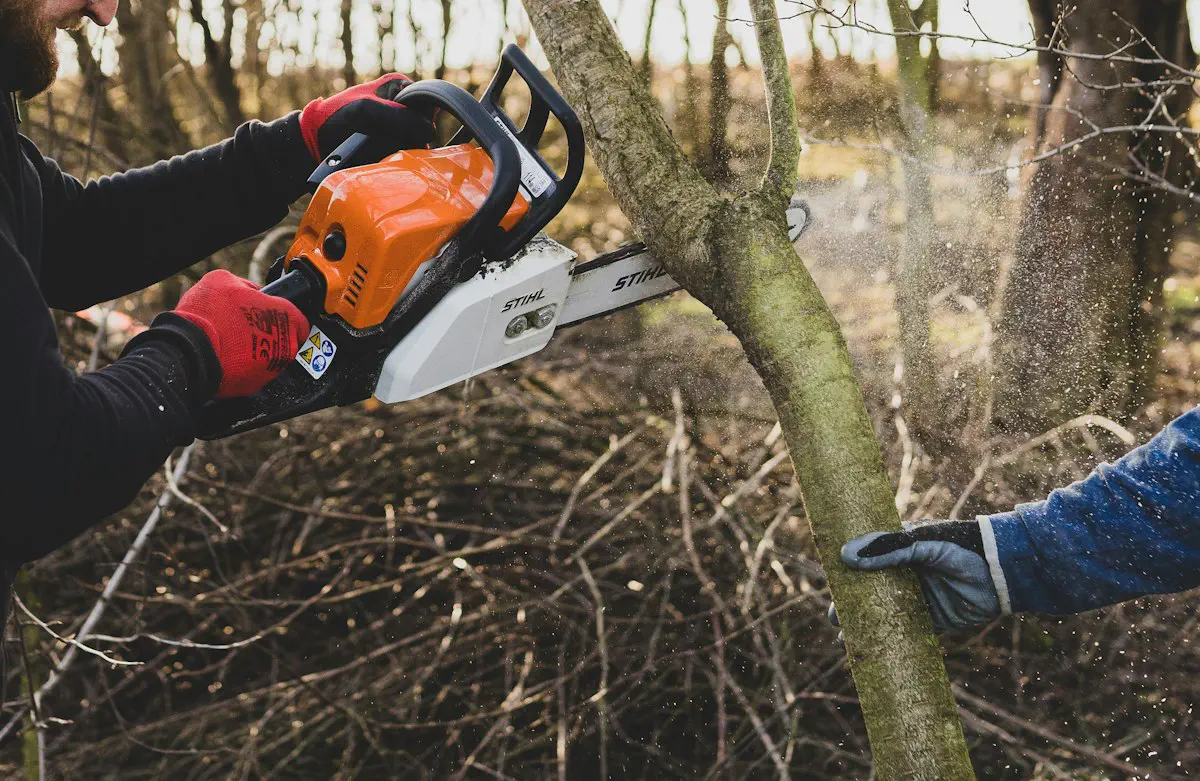
A maple dying in the backyard, a tree service quote for Thursday, and the surprise: the City decides. In Montreal, the tree cutting permit is requested from the borough, and the published fees range from $58 to $268 depending on the address. In Laval, it is $84 per tree and a paper form sent by mail. Here is the real process, the reasons that get accepted, the ones that get refused, and what cutting a tree without authorization costs.
The City of Montreal is explicit: to cut down a tree on your property, a felling permit, also called a certificate of authorization, is required. The threshold, however, belongs to the borough. In Ahuntsic-Cartierville, the certificate is required for a trunk 10 cm in diameter or more, measured 1.3 m above the ground. In Lachine, it is also 10 cm, but cedar, juniper and buckthorn can be cut without a permit whatever their diameter.
And it is not only about the saw. In Ahuntsic-Cartierville, the certificate is also required to raise the soil under the crown by more than 20 cm, to cut 40% or more of the branches and to cut 40% or more of the roots. That is the line that catches owners who have excavation done.
In Laval, the threshold is lower and the City leaves no grey area: “Before cutting down a tree on your property, even if the request comes from a recommendation by Hydro-Québec, you must obtain a certificate of authorization.” The requirement covers deciduous trees 30 mm in diameter and up and conifers 150 cm tall and up, wherever the tree stands on the lot. Section 412 of the urban planning code also treats as felling the removal of more than 50% of the living crown and the severing of more than 40% of the anchoring roots. Who owns the tree is a separate question, settled in the Code civil du Québec: it is covered in the piece on the tree, the neighbour and the by-law.
The permit is not a formality. Montreal publishes the admissible reasons: the tree is dead, it is in a state of irreversible decline, it is causing serious damage to property, it endangers public safety, it risks spreading a disease or an invasive exotic species, or it stands in the footprint of a future construction or less than 3 metres from that footprint.
The reason most often given is precisely a prohibited one. Montreal lists what gives you no right to anything: falling flowers, leaves, sap or twigs, pollen, animals and insects, shade, roots visible at the surface of the ground, and the fact that the tree hinders the growth of more valuable trees. That last point deserves a warning, because the opposite is often written: in its online form, Ahuntsic-Cartierville specifies that you must not select this reason, because no certificate can be issued on that basis.
Laval keeps an equivalent list in section 410 of its urban planning code, and it adds a burden of proof: considerable damage to buildings and major structural weaknesses must be demonstrated by a report from an arboriculture professional of the City.
The file looks the same from one borough to the next: a scale plan, ideally the certificat de localisation, on which each tree is numbered with its diameter and species, photos of the trees involved, and in most cases the report of an expert recognized by the borough, a forest engineer or an agronomist. In a condo, add a letter of authorization from each co-owner or a resolution of the syndicate. An inspector then visits the site. In Laval, if the trunk straddles the property line, the form requires the neighbour’s name and written authorization.
The certificat de localisation is therefore the document to pull out before you call the tree service. It is also one of the first documents I gather when I prepare a listing: it is what shows where the boundaries are.
| Territory | Published fees | Published processing time |
|---|---|---|
| Laval | $84 per tree | not published |
| Rivière-des-Prairies, Pointe-aux-Trembles | $58 per property | not published |
| Villeray, Saint-Michel, Parc-Extension | $64 per tree, residential | not published |
| Pierrefonds-Roxboro | $70 per request | 4 weeks |
| Ahuntsic-Cartierville | $136 per request and per lot | not published |
| Rosemont, La Petite-Patrie | $162 per tree | 6 to 8 weeks |
| Outremont | $177.80 per tree | 10 business days |
| Verdun | $268 per tree | not published |
The real difference is not the amount, it is the unit. A fee per request caps the bill whatever the number of trees, a fee per tree multiplies it. Le Sud-Ouest grants a 50% reduction to owner-occupants aged 65 and over, and Saint-Laurent issues the certificate free of charge when the tree is dead. The same logic of prior authorization applies to other structures on a lot, as the guide to the shed, carport and garage permit shows.
The emerald ash borer has its own framework, still in force: the Règlement relatif à la lutte contre l’agrile du frêne (the by-law on the fight against the emerald ash borer). The procedure is separate from the one for other trees, and a request for a certificate to cut an ash tree is free, in Montreal as in Laval. If the inspection reveals that the tree is not an ash, the analysis fees become payable again.
An ash tree owner has obligations, not just rights. Montreal writes that a healthy ash must be treated against the borer every 2 years, a service offered free of charge on request made between May 1 and July 31. A dead ash, for its part, must be cut down, at the owner’s expense.
Three deadlines to remember. If you receive a felling notice from the City, you have 30 days to file the permit application, or face a fine. Once the certificate is issued, you have 365 days to cut the tree, or face a fine. Replacement is mandatory, and failing to replace is also subject to a fine. Montreal pays a grant of $10 per centimetre of diameter for each ash tree cut down, to be requested within 365 days of the felling, but only if you let the City plant the replacement tree. And it is prohibited to keep unprocessed ash wood, and therefore to keep it as firewood.
This is the number almost no one knows. Laval’s urban planning code puts no amount in its table of fines for the line “illegally cutting down a tree”: it refers to the Act respecting land use planning and development. According to the ministère des Affaires municipales et de l’Habitation, that Act sets a minimum fine of $500, to which is added, for felling on an area of less than one hectare, an amount of $100 to $200 per tree illegally cut, up to a maximum of $5,000. For one hectare or more, it is $5,000 to $15,000 per full hectare cleared. These amounts are doubled for a repeat offence. Lachine puts a figure on the same thing its own way: the fine is $600 and can go up to $15,000 depending on the number of trees cut and the area cleared.
And the proof is easier to make than people think. In Laval, section 410 provides a presumption of illegal felling as soon as the stump left in place measures at least 4 cm in diameter, measured no higher than 15 cm above the ground. The stump talks.
The permit is not the end of the obligation, it is the beginning. In Montreal, every tree cut down must be replaced within 12 months of the certificate being issued, by a single trunk deciduous tree at least 3 cm in diameter and 2 m tall, or by a 1 m conifer. Within 100 m of an eco-territory or a wooded area, the replacement tree must be native.
In Laval, replacement is due within 6 months of the certificate being issued, not counting December, January, February and March. It is required when the remaining number of trees drops below a ratio of one tree per 100 m² of lot, but also, and this is the part that matters for a buyer, when a tree was cut in contravention of the by-law, or when the work that justified the felling was never carried out. This obligation does not follow the owner who did the cutting. It stays attached to the property.
The mandatory Déclarations du vendeur sur l’immeuble form, DV 00001 in its version 24 of June 2022, asks no question about trees. Irregular felling is therefore declared elsewhere, and two boxes are enough. D2.12: “Have you ever received a notice of non-compliance from an insurance company, the municipality or the government?” D14.4 b): “Were the required permits issued for each of these works?” That leaves D14.5 for any other element that may have an impact on the value or use of the property, and D15 for details. How the form works is explained in the piece on the seller’s declaration.
On the insurance side, the Insurance Bureau of Canada points out that a tree’s owner is not liable for damage caused by a windstorm, unless they were negligent, and its example is the rotten tree that was not cut down. Hence a simple reflex: if you apply for a permit for a tree you consider dangerous and the City refuses, keep the refusal in writing. As for what your contract covers after that, your insurer answers, not me.
My tree service is coming Thursday. Can I cut now and sort it out afterwards? No. Montreal writes that the certificate must have been obtained before proceeding, and the published processing time ranges from 10 business days in Outremont to 6 to 8 weeks in Rosemont, La Petite-Patrie. Felling done before the certificate is an offence, and the replacement obligation is added to the fine.
The tree casts shade and hinders my other trees. Is that a reason? No, in both cases. Shade appears on the list of refused reasons in Montreal as in Laval, and hindering the growth of more valuable trees is also a refused reason, to the point that Ahuntsic-Cartierville asks you not to select it in its online form.
If the City refuses, do I get my fees back? Not necessarily. Villeray, Saint-Michel and Parc-Extension specifies that the amounts paid for reviewing the file are not refundable if the permit is refused or the request is cancelled. Le Sud-Ouest and Pierrefonds-Roxboro also write that their fees are not refundable.
I am buying a house where three trees were cut down last year. What should I ask for? The certificates of authorization, proof of replacement, and a written answer to D2.12. If the property is in Laval and stumps of 4 cm or more are still visible, the presumption of illegal felling applies, and the obligation to plant stays attached to the land you are buying.
To go further, read the checks before buying vacant land and the seven red flags that justify walking away.
A tree is complicating your project, or you are inheriting a felling done by the seller? Write to me. I check the borough’s or the city’s by-law, and the replacement obligation, before you sign anything.

Residential Real Estate Broker · RE/MAX DU CARTIER INC.
Contact GeorgesRedoing a flat roof in Montreal is no longer a colour choice. The list of permitted coverings is closed, and the …

The sales representative announces an insurance discount, sometimes a precise percentage. Nobody shows you the grid …
Choosing the month you list is settled elsewhere. What never is: once the decision is made, fall and winter add …