Practical Guide
The True Cost of an In-Ground Pool in Quebec
The installation price of a pool gets negotiated once. The rest gets paid every year, and that is the part almost …
Practical Guide
Two houses of the same age, on the same street in Laval, can show a gap of several hundred dollars per winter. It is almost never a question of habits. It is the structure of the Hydro-Québec rate meeting a building envelope, and the result reads in black and white across twelve months of bills.
Rate D is the basic domestic rate. Its structure is set out in section 2.5 of the electricity rates schedule, in force since April 1, 2026, and it has only three pieces.
| Item | Price under Rate D, since April 1, 2026 |
|---|---|
| System access fee | 46.154 cents per day |
| Energy, up to 40 kWh per day | 7.065 cents per kilowatt hour |
| Energy, above 40 kWh per day | 11.142 cents per kilowatt hour |
The system access fee does not move, whatever you consume. So everything plays out on the two energy tiers. And the second one costs close to 58 % more than the first.
The 40 kWh threshold is multiplied by the number of days in the consumption period. Over a 30 day month, the first tier therefore covers 1,200 kWh. In July, almost nobody exceeds it. In January, an electrically heated house crosses it within the first few days, and everything else that month is billed at the top price. That is where the gap opens: the poorly insulated house does not just consume more, it consumes in the most expensive tier.
There is also a Rate DT, reserved for accounts with a dual energy system compliant with section 2.31. Energy there is billed at 5.131 cents per kilowatt hour as long as the temperature stays at or above -12 °C or -15 °C depending on the climate zone, then 30.001 cents below that. Dual energy is therefore not automatically a saving.
In a Quebec household, Hydro-Québec breaks consumption down this way: 54 % for heating and air conditioning, 20 % for hot water, 18 % for appliances and electronics, 5 % for lighting, 3 % for the rest. A detached single family home with no air conditioning and no pool consumes an average of 22,000 kWh per year.
The figures on losses are published by Hydro-Québec and they are severe. Poorly insulated walls, attics and foundations can lose up to 40 % of a home’s heat. Air leaks can carry away up to 25 %. Doors and windows, up to 25 % as well. The number of occupants, for its part, has little effect on heating.
In practical terms: you are not heating your house, you are heating its leaks. And no appliance, however efficient, makes up for a punctured envelope.
Caulking first. It is the cheapest and most profitable move, because it goes straight at the 25 % of heat that escapes through leaks. It targets windows, exterior doors, the attic hatch, kitchen range hoods, bathroom fans, electrical outlets and fireplaces. The result is measurable: the blower door test gives an air changes per hour rate, and that rate is what the grant programs look at.
The attic next. Heat rises, and the roof is the surface where insulation is easiest and cheapest to lay. Hydro-Québec sets the target in its LogisVert program (its residential energy efficiency program): a thermal resistance of at least RSI 8.8, meaning R-50, over 100 % of the roof area. On the Rénoclimat side (the Quebec government’s home energy retrofit program), the rule is different: you have to insulate at least 20 % of the surface of the targeted assembly to qualify for the grant.
Before concluding that your attic is fine because there is batt insulation in it, have the actual thickness and the uniformity checked. That is exactly the kind of item covered by the pre-purchase inspection checklist.
Hydro-Québec estimates that a heat pump cuts heating related electricity consumption by about 25 % compared with baseboards alone. Some high efficiency models operate down to -25 °C, and even -30 °C.
But the heating capacity of an air source heat pump drops as the mercury falls, and a backup remains necessary. Hydro-Québec gives the setting: the heat pump at about 21 °C, the baseboards 2 to 3 degrees lower, at 18 or 19 °C, so they only start up when it is genuinely cold. A heat pump that completely replaces baseboards is not a realistic scenario here.
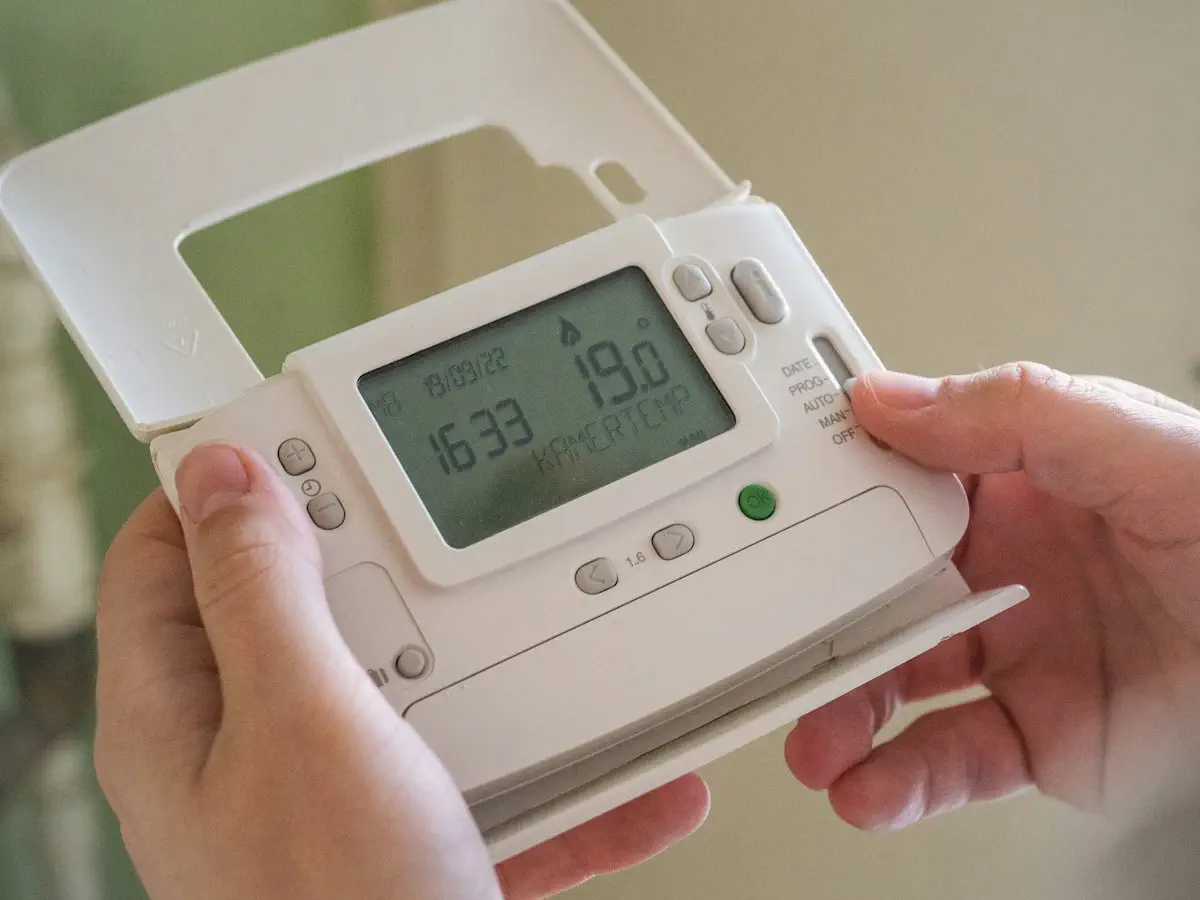
Replacing old bimetal dial thermostats with electronic thermostats can cut the annual electricity bill by 10 %, according to Hydro-Québec.
One detail surprises a lot of owners: in the September 15, 2026 version of the LogisVert residential participation guide, thermostats are not among the eligible measures. Smart thermostats are still offered free of charge under the Flex D rate with Hilo, which is a separate offer, with its own conditions.
Hot water is 20 % of a household’s consumption. Hydro-Québec is clear on the setting: keep the water heater at 60 °C, there is no reason to go higher. Insulate the water heater and the hot water pipes that cross cool or unheated spaces, and repair leaking taps.
When you compare the cost of owning a house with your current rent, put heating in the column, with the rent versus buy calculator.
Rénoclimat, Government of Quebec: open. The program has no announced end date. Its central rule has to be understood before you pick up a hammer: you must obtain the home energy evaluation before starting the work. Any work already done or started before the first evaluation is not eligible. The pre-work evaluation costs $150 plus taxes, refunded if the financial assistance is granted, and the first post-work evaluation is free.
| Work | Rénoclimat grant |
|---|---|
| Air sealing, target met | $400 |
| Air sealing, target exceeded by 10 % | $600 |
| Air sealing, target exceeded by 20 % | $800 |
| Roof, attic or flat roof | up to $1,500 |
| Exterior walls | up to $3,750 |
| Basement foundation wall | up to $2,500 |
| Crawl space wall | up to $2,000 |
LogisVert, Hydro-Québec: open. The heat pump grant is $50 per 1,000 BTU/h at -8 °C for an ENERGY STAR certified unit, and $120 per 1,000 BTU/h at -8 °C if it is ENERGY STAR certified cold climate type. Roof insulation with caulking is worth $1,500, once per dwelling, and both types of work must be carried out together. Bundling at least two different measures in the same application adds a 5 % bonus. The application must be submitted no later than nine months after the measure is put in place, and the company doing the work must hold the appropriate licence from the Régie du bâtiment (Quebec’s building authority).
Chauffez vert: finished. The government financial assistance for converting a central oil or propane system (the Chauffez vert conversion program) has not been offered since March 31, 2026. No application received after that date is accepted. If a seller or a contractor mentions it as available help, the information is out of date.
Éconologis: seasonal, and already full. This free service (the Quebec energy efficiency service for low income households) is aimed at modest income households, owners and tenants alike, from October 1 to March 31. Registrations for the 2026-2027 season are closed, the maximum number of visits having been reached.
| Rank | Action | Possible grant in 2026 |
|---|---|---|
| 1 | Caulking and air sealing | Rénoclimat, $400 to $800 |
| 2 | Attic insulation | Rénoclimat or LogisVert, up to $1,500 |
| 3 | Electronic thermostats | None under LogisVert |
| 4 | Heat pump with backup | LogisVert, $50 or $120 per 1,000 BTU/h |
| 5 | Water heater and insulated pipes | None |
| 6 | Doors and windows | Rénoclimat |
Doors and windows come last on the list, and that contradicts the order in which most owners spend. It is not that they do not count, it is that their cost per degree recovered is the highest of the lot. The same reasoning applies at selling time, as explained in what renovation actually gets back.
The last twelve months of Hydro-Québec bills. Not an average, not an equalized monthly amount: the actual statements, over a full year, with the kilowatt hours. You will see three things in them: January and February consumption, how far into the second tier the house goes, and the lifestyle of the occupants, which is not yours.
If the seller supplies nothing, Hydro-Québec offers an electricity cost estimating tool where you simply enter the building number and the postal code of the address you are interested in, and the estimate comes out on the spot.
I also ask for the year the heat pump was installed and the invoices for the insulation work, because a grant already paid on a building closes the door on a second one for the same work. Add those documents to your first visit checklist.
Will a heat pump eliminate my baseboards? No. The heating capacity of an air source heat pump drops in deep cold, and Hydro-Québec recommends keeping a backup, set 2 to 3 degrees below the heat pump.
Can I combine Rénoclimat and LogisVert? Not for the same work. By accepting a LogisVert grant, you undertake not to claim other government assistance for the same equipment or the same work. Different measures in the same house, yes. The same roof twice, no.
Does the Chauffez vert program still exist? No. It ended on March 31, 2026 and no application received after that date is accepted.
I have started my work, can I apply to Rénoclimat? No. The energy evaluation must come before the work. Anything already done or started before the first evaluation is excluded from the financial assistance.
To go further, read the hidden costs of homeownership and the pre-purchase inspection checklist.
Torn between two properties and worried about heating on one of them? Write to me. We get the seller’s bills and read them before drafting the offer, not after signing.

Residential Real Estate Broker · RE/MAX DU CARTIER INC.
Contact GeorgesThe installation price of a pool gets negotiated once. The rest gets paid every year, and that is the part almost …
Two violent storms in one summer are enough to turn a finished basement into a claim. In Montreal as in Laval, the …

An empty basement, an attached garage used as a shed, a lot deeper than the others on the street. The reflex is to …