
Buyer's Guide
Roof and Window Lifespan in Quebec
Two 1998 houses on the same Laval street. One has a roof redone in 2019 and windows replaced in 2015, the other …
Buyer's Guide
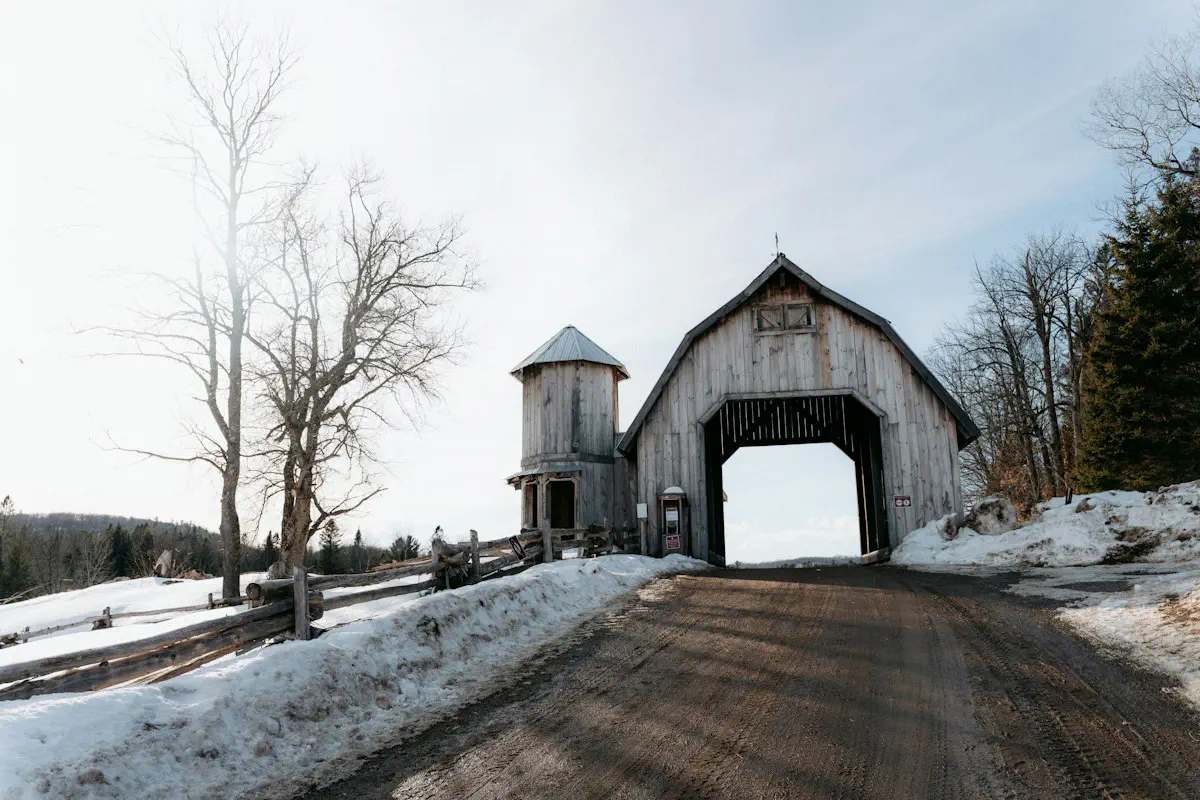
A principal residence in the country is not a cottage with the heat turned up. The rules that govern it come from the Commission de protection du territoire agricole (CPTAQ, Quebec’s agricultural land commission), the MRC, the municipal council and the insurer, never from the seller. Here is what changes when a rural address becomes the one where you live year round.
The first document to ask for is not the certificat de localisation, it is the zoning attestation. The protected agricultural zone covers more than 63,500 square kilometres and extends over the territory of 955 municipalities, in all 17 administrative regions of Quebec. Since November 9, 1978, on a territory identified by decree, using land for purposes other than agriculture, subdividing land, removing topsoil and cutting maple trees in a sugar bush have been prohibited there.
The Commission sums up its rule without nuance: in the agricultural zone, you may not subdivide, alienate or use a lot for purposes other than agriculture without first obtaining its authorization. “Alienate” means sell, transfer or give. So it is not only your project that can run into the Act, it is sometimes the transaction itself. Any applicant can also obtain from the Commission an official document attesting whether or not a lot is located in the agricultural zone, by supplying the required information and paying the fees provided for in section 15. A listing sheet does not replace that paper.
A house that exists legally in the agricultural zone rests on a right, and not every right is sold with it. The real rights under sections 101, 103, 104 and 105 are attached to the lot: they apply to the extent that a non-agricultural use was legally carried on or authorized there at the time the Act became applicable to it. The personal rights under sections 31, 31.1 and 40 are attached to the owner, and do not follow the property.
An acquired right can be extinguished. Section 102 extinguishes it when the area that benefits from it has remained under plant cover for more than one year since the provisions of the Act came into force on the lot, or after an alienation. The Commission specifies that this section does not target sections 104 and 105. A lot gone to fallow is therefore not an aesthetic detail.
Adding a use is not automatic. Since June 21, 2001, adding or changing a principal use for a purpose other than agriculture, within the area of acquired rights, requires the Commission’s authorization (section 101.1).
The additional dwelling is blocked. Since Bill 86 was tabled on December 5, 2024, you may not add or build an additional dwelling, an additional residence or any other additional building in which a dwelling is set up, on an area benefiting from a residential acquired right, without the Commission’s authorization (section 101.2). Transitional measures cover those who held a valid notice of compliance between June 21, 2001 and December 5, 2024, with five years starting March 25, 2025 to begin the work. An intergenerational plan is therefore decided here. The checks before buying vacant land go over this Act from the point of view of a bare lot.
Article 976 of the Code civil du Québec requires neighbours to accept the normal neighbourhood annoyances, according to the nature or location of their land, or according to local custom. In the agricultural zone, the nature of the land and local custom are agricultural.
The rest is in writing. The complementary document to the land use and development plan of an MRC whose territory includes an agricultural zone must contain parameters for determining the separation distances referred to in the third paragraph of section 113 of the Act respecting land use planning and development. These parameters take up the normative framework of the government orientations, which sets spreading distances measured from any dwelling house.
| Spreading | June 15 to August 15 | Rest of the year |
|---|---|---|
| Liquid manure by tanker, on the surface | 75 m | 25 m |
| Liquid manure by tanker, incorporated | 35 m | None |
| Liquid manure by drop hose, on the surface | 40 m | None |
| Fresh solid manure, on the surface | 40 m | None |
| Compost | 20 m | None |
“None” means spreading is allowed right up to the edge of the field, as long as the other laws and regulations are respected. Ten months a year, the field next to your porch is therefore fully available.
The framework works in the other direction when a new dwelling house is built near an existing commercial livestock operation: 322 metres from a hog fattening operation, 119 metres from a dairy farm, 25 metres from a cultivated field. If you are buying to rebuild, ask for the zoning grid and the MRC’s interim control by-law.
No municipality is required to maintain a private road. Section 70 of the Municipal Powers Act gives it a discretionary power to maintain a private road open to the public by tolerance, at the request of a majority of the owners or occupants along it. Saint-Donat, in the MRC de Matawinie, has turned this power into a by-law, and its text shows what a municipal “yes” looks like: a road accessible at all times, connected to a public road or to a private road already maintained, cleared for emergency vehicles, at least 100 metres long, serving at least 4 dwellings, with a request filed before June 30 and signed by the majority of the owners along it. The council keeps full discretion to accept or not.
The service is paid for by the owners along the road. In Saint-Donat, winter maintenance runs from October 15 to April 30, snow is cleared over a width of six metres, and the charge is levied with the property tax, split equally over each assessment unit, at the net cost of the service plus administrative fees of about 3%. That item shows up on the tax bill.
If the roadbed is held in undivided co-ownership, the Code civil takes over. The co-owners manage the property together (article 1025) and bear the administration costs and other common charges in proportion to their share (article 1019). Administrative decisions are taken by a majority of the co-owners, in number and in shares, but unanimity is required to alienate the property, partition it, charge it with a real right, change its destination or make substantial changes to it (article 1026). Have the notary determine which category replacing a culvert falls into. For winter, liability for snow removal stays the same as in the city.
The Insurance Bureau of Canada names seven factors that determine the rate in home insurance. One of them is proximity to a fire hydrant or a fire station: if the home is not close to one, it could cost more to insure. The IBC publishes no percentage, and no one can honestly give you one. The only reliable answer is a written quote obtained before you waive your financing condition, as with any hard to insure home.
The SCHL (CMHC) purchase program sheet is clear: the property must be habitable and ready to be occupied at all times, and accessible year round. A private road with no written maintenance agreement is hard to defend against that sentence.
The appraisal can cost more than the rate. The SCHL writes that down payment requirements rest on the lending value, which is the lowest of the property’s market value, its purchase price and its construction cost. In a rural market, where comparable sales are rare and sometimes far away, the lender’s appraisal can come in below your accepted price. The gap is not financed, it is paid in cash. Run both scenarios with the mortgage calculator, and read how a comparable is built.
On resale, no promises. The APCIQ publishes by census metropolitan area and by broad sector, not according to how rural a property is. In August 2026, in the Montreal CMA, single-family homes sold in 42 days on average and inventory rose 26% year over year on the North Shore. No equivalent public series puts a figure on the resale time for a rural road outside the CMA.
Internet. Opération haute vitesse ended in March 2024 and more than 339,500 households now have access to a service offering at least 50 Mbps download and 10 Mbps upload, with no data cap. The government publishes an interactive map giving service status by civic address, last published on August 28, 2026: served, project under way, or service to be confirmed. The subsidized satellite program ended on March 31, 2026.
Collection. On a private road, the truck does not always come to your door. In Sainte-Lucie-des-Laurentides, by-law 648-24 provides that units not fronting on a public road leave their bins at the nearest intersection between the private road and the public road.
School transportation. No provincial distance threshold exists. Student transportation is organized by the centre de services scolaire (school service centre), which sets its terms, and it cannot be required if the student lives outside the area served by the school, as defined by that centre. Write to it with the civic address, before the offer.
| Check | The document to obtain |
|---|---|
| Agricultural zone | The zoning attestation, by lot number |
| Acquired right | The notice of compliance or the Commission’s decision |
| Odours | The zoning grid and the interim control by-law |
| Road | The status, the maintenance agreement, the resolution, the tax bill |
| Undivided co-ownership | The published deed, the agreement, the budget of charges |
| Insurance and loan | A written quote, the lender’s position |
| Services | The Internet map, the collection by-law, the school service centre’s reply |
The well and the septic system are checked as for a cottage, with one difference: year round occupancy changes the daily flow and the pumping schedule. The documents to request are in the checks before buying a cottage. Each line becomes a dated condition in the promesse d’achat.
The house is in the agricultural zone. Can I still buy it? Often yes, because an acquired right attached to the lot already exists. But alienating a lot in the agricultural zone may require the Commission’s authorization, or a declaration of exercise of a right. That is a question for the notary and the Commission before the promise to purchase, not after.
I want to add a unit for my parents. Is it possible? Not without the Commission’s authorization since section 101.2, on an area benefiting from a residential acquired right. Have the lot’s file checked before buying for that project.
The municipality has cleared the road for ten years. Is that guaranteed? No. Section 70 of the Municipal Powers Act is a power, not an obligation. Ask for the resolution in force and the amount billed on the tax bill.
How much will my insurance premium go up far from a fire station? No official source puts a figure on it. The Insurance Bureau of Canada only confirms that this distance is one of the rating factors. Get two or three written quotes for the exact address.
To go further, read the checks before buying vacant land and what a real comparable contains.
Looking at a country road in the Laurentians, Lanaudière or Montérégie? Write to me. We request the zoning attestation and the municipal documents before you file a promise to purchase.

Residential Real Estate Broker · RE/MAX DU CARTIER INC.
Contact GeorgesTwo 1998 houses on the same Laval street. One has a roof redone in 2019 and windows replaced in 2015, the other …
Nothing stops someone from calling themselves a home inspector tomorrow morning in Quebec. The trade has started to …
You have lived together for twelve years, the house is in his name, and you have paid half of every mortgage …